
Enter your wrist size below and this tool gives you a case diameter range, a maximum lug-to-lug, and — because it’s the only sizing calculator wired into a real, in-stock, priced Australian catalogue — a page of watches you can actually buy today that fit. Every other size calculator hands you a number and leaves; this one hands you the watch. And it starts from lug-to-lug, not case diameter, because lug-to-lug — the span across the outer edges of the lugs — is the measurement that actually decides whether a watch overhangs your wrist.
Lug-to-lug — not case diameter — decides whether a watch overhangs your wrist. Two watches with the same diameter can differ by 5mm+ here depending on lug shape.
Anything up to 47.6 mm sits within your wrist without overhanging. Under 43.3 mm the lugs disappear completely — the difference between a watch that fits and one you forget you are wearing.


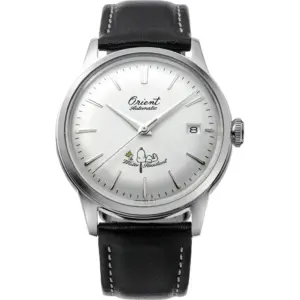 Orient Bambino RA-AC0M16S Peanuts 75th Anniversary Automatic Dress Watch
38.4 mm case · 44 mm L2L
Great fit
A$600.00
Orient Bambino RA-AC0M16S Peanuts 75th Anniversary Automatic Dress Watch
38.4 mm case · 44 mm L2L
Great fit
A$600.00

How to measure your wrist
- Find the right spot. Locate your wrist bone, then move the tape just past it — the spot where a watch case actually sits when you wear one, not further up the forearm.
- Wrap a soft tape measure around your wrist at that spot — or a strip of paper and a ruler, if that’s what you’ve got.
- Pull it to strap tension. Snug, the same tension you’d want from a watch strap, not a blood pressure cuff.
- Read the measurement in centimetres and enter it into the calculator above.
- If you’re between two readings, measure again later in the day. Wrists swell slightly with heat and activity, so an evening measurement is usually the more honest one to size against.
Why lug-to-lug matters more than case diameter
Case diameter is the number watch marketing leads with, because it’s a single easy figure to print on a spec sheet. But diameter only measures a circle — it says nothing about how far the case actually reaches across your wrist, because lugs are rarely flush with the case edge.
Lug-to-lug is the distance between the two outermost points of the lugs, the metal tabs the strap attaches to. It’s the number that actually determines fit, because it’s the full span of the case sitting on your skin.
The gap between the two figures depends entirely on lug design, and it varies more than most buyers expect. Two watches from our own catalogue make the point: an Orient Bambino RA-AC0M02B30B has a 38 mm case, but its long, near-flat lugs push the lug-to-lug out to 44 mm — 16% larger than the case number suggests. A Seiko Prospex Turtle SRPJ35 has a considerably bigger 45 mm case, but its cushion shape curves the lugs in close, landing at 47.7 mm lug-to-lug — only 6% over. On paper the Turtle looks 7 mm bigger. On the wrist, it’s barely 4 mm bigger.
That’s why the calculator above asks for your wrist size rather than a target case diameter, and why every result shows both numbers.
Watch size chart by wrist measurement (cm, mm and inches)
Wrist size drives case diameter and lug-to-lug together, not independently — this table runs the same maths as the calculator above in half-centimetre steps, with the inch conversion alongside so you don’t need a separate calculator just to convert cm to inches.
| Wrist (cm) | Wrist (mm) | Wrist (in) | Recommended case Ø | Max lug-to-lug |
|---|---|---|---|---|
| 13 cm | 130 mm | 5.1 in | 28.5–32.6 mm | up to 36.4 mm |
| 13.5 cm | 135 mm | 5.3 in | 29.7–33.7 mm | up to 37.8 mm |
| 14 cm | 140 mm | 5.5 in | 30.9–34.9 mm | up to 39.2 mm |
| 14.5 cm | 145 mm | 5.7 in | 32.1–36.1 mm | up to 40.6 mm |
| 15 cm | 150 mm | 5.9 in | 33.3–37.3 mm | up to 42 mm |
| 15.5 cm | 155 mm | 6.1 in | 34.4–38.4 mm | up to 43.4 mm |
| 16 cm | 160 mm | 6.3 in | 35.6–39.6 mm | up to 44.8 mm |
| 16.5 cm | 165 mm | 6.5 in | 36.8–40.8 mm | up to 46.2 mm |
| 17 cm | 170 mm | 6.7 in | 37.9–41.9 mm | up to 47.6 mm |
| 17.5 cm | 175 mm | 6.9 in | 39.1–43.1 mm | up to 49 mm |
| 18 cm | 180 mm | 7.1 in | 40.3–44.3 mm | up to 50.4 mm |
| 18.5 cm | 185 mm | 7.3 in | 41.5–45.5 mm | up to 51.8 mm |
| 19 cm | 190 mm | 7.5 in | 42.7–46.7 mm | up to 53.2 mm |
| 19.5 cm | 195 mm | 7.7 in | 43.8–47.8 mm | up to 54.6 mm |
| 20 cm | 200 mm | 7.9 in | 45–49 mm | up to 56 mm |
| 20.5 cm | 205 mm | 8.1 in | 46.2–50 mm | up to 57.4 mm |
| 21 cm | 210 mm | 8.3 in | 47.3–50 mm | up to 58.8 mm |
These are balanced-fit midpoints. Diver and chronograph styles wear larger for the same wrist; dress and minimalist styles wear smaller — set your style above to see the adjusted range. To convert any wrist measurement yourself: cm × 10 = mm, and cm ÷ 2.54 = inches — so a 16.5 cm wrist is 165 mm, or 6.5 in.
How specific models actually wear
Case diameter alone doesn’t tell you how a watch sits on your wrist. These notes are pulled from the verified and measured specs on our own product pages, not general rules of thumb.
- Orient Bambino (dress line)
- Runs long on the wrist despite a modest case — see our full Orient Bambino buying guide for model-by-model detail. Even the 38.4 mm case sizes reach 44 mm lug-to-lug, and the 40.5 mm versions push out to 46–46.5 mm — and at roughly 11.5 mm thick with a domed crystal, the Bambino also sits proud rather than flush, so it reads larger than the diameter alone suggests. If your wrist is under 16 cm, look at the 38.4 mm Bambino cases specifically rather than the 40.5 mm — the lug-to-lug gap between them is bigger than the case numbers imply, and on a narrow wrist that gap is the difference between the lugs sitting flush and overhanging.
- Orient Mako / Kamasu (dive line)
- More moderate than the Bambino — full specs in our Orient Mako buying guide. A 41.8–42 mm case lands around 46.5–46.8 mm lug-to-lug — still larger than the case suggests, but a smaller jump, because the lugs angle down rather than running flat. Case thickness is around 13 mm, so it wears like a proper dive watch with presence, but the downward lug angle means it hugs a smaller wrist better than the numbers alone would predict. Sits comfortably from about 16.5 cm up.
- Seiko 5 Sports GMT (SSK series)
- Among the truer-to-size options in the catalogue: a 42.5 mm case reaches only 46 mm lug-to-lug, a tighter ratio than most divers this size, at roughly 13.2 mm thick. That tight ratio is what lets it work on wrists that would normally rule out a 42.5 mm diver — the case looks bigger on paper than it wears.
- Seiko Prospex Turtle
- Looks large on paper at 45 mm (for a same-family reference point on a smaller Seiko 5, see our SNK809 buyer guide), but the cushion case curves the lugs in close, landing at 47.7 mm lug-to-lug — only 6% over the case number, against the ~16% typical of a round-cased watch this size. At around 13.2 mm thick with a wide case, it still reads bold on anything under 17 cm, but it wears nearer to its diameter than a round case that size would, which is why it suits more wrists than the 45 mm spec implies.
- Seiko Presage Cocktail Time (compact cases, e.g. SRP837)
- Don’t judge these by the case number alone — a 33.8 mm dial still carries the watch out to 40.4 mm lug-to-lug, and at roughly 11.6 mm thick with a domed crystal it has more visual presence on the wrist than “33.8 mm” implies. Small dial, not a small footprint — a genuinely good option for a wrist that wants a dressy watch without a large-diameter case.
- Vostok Amphibia
- Fairly average — a 41 mm case reaches 45 mm lug-to-lug, close to the typical ratio for a dive case this size, and at around 14 mm thick (case-back glass adds a little) it’s one of the chunkier watches in this list underneath, even though the diameter reads mid-size. A safe middle-of-the-road pick from roughly 16 cm up — browse the full Vostok range.
Case-diameter and lug-to-lug figures above are pulled from our own product listings; thickness figures are typical for the line rather than caliper-measured per SKU, and are given as a wearing guide rather than a spec. For more on choosing between these brands generally, see our Orient vs Seiko comparison and men’s automatic watch buying guide — or browse the full Orient and Seiko ranges.
Where a product page doesn’t have a caliper-measured lug-to-lug on file yet, the calculator above estimates it from case diameter and case shape and marks it “est.” — treat that as a close guide, not a spec.
Frequently asked questions
How many inches is a 16.5 cm wrist?
A 16.5 cm wrist is 6.5 inches (16.5 ÷ 2.54 = 6.5″). To convert any wrist size yourself, divide centimetres by 2.54, or use the cm/mm/in size chart above, which lists the conversion in 0.5 cm steps from 13 cm to 21 cm.
Is case diameter or lug-to-lug more important for fit?
Lug-to-lug. Case diameter is a useful starting point and the number most listings lead with, but it’s lug-to-lug that determines whether a watch actually overhangs your wrist. Two watches with the same diameter can differ by 5 mm or more in lug-to-lug depending on how the lugs are shaped.
My wrist measurement falls between two calculator results — which way should I go?
Round down if you prefer a slimmer, classic fit. Round up for sport and diver styles, which are designed to sit boldly rather than flush. The style selector above already applies a similar adjustment automatically.
Does strap material affect how a watch wears?
Yes. Leather and rubber straps flex around the wrist, so a slightly larger lug-to-lug is more forgiving on a leather strap than the same number would be on a rigid metal bracelet.
What does the “est.” badge next to lug-to-lug mean?
It means we haven’t measured that exact model with a caliper yet. The figure is calculated from the case diameter and case shape, which gets close but isn’t a substitute for a real measurement. We’re working through our catalogue to replace estimates with verified numbers, starting with our best-selling models.
Is a smaller case diameter always more comfortable?
Not necessarily. Case thickness and how sharply the lugs curve down matter as much as diameter — a thick, flat-lugged 38 mm watch can wear less comfortably than a slim 42 mm one.
Why does the calculator ask for style and fit preference, not just wrist size?
Because a 40 mm dress watch and a 40 mm diver wear differently on the same wrist — bezels, crowns and case shape all change how a watch reads at a given diameter. Style and fit preference adjust the recommended range to account for that.
What wrist sizes does the calculator support?
Roughly 13 cm to 23 cm (about 5.1″ to 9″). Outside that range the maths starts to extrapolate beyond what’s typical for an adult wrist, so we cap it there rather than show a number we can’t stand behind.